
Guide
Handheld Laser Welding: Setting Wobble Width and Travel Speed from the Process Chart
Wobble frequency, spot width and travel speed decide whether a handheld laser weld repeats. How to read the LY-1000 and LY-1500 process chart, and which three variables move a weld away from it.
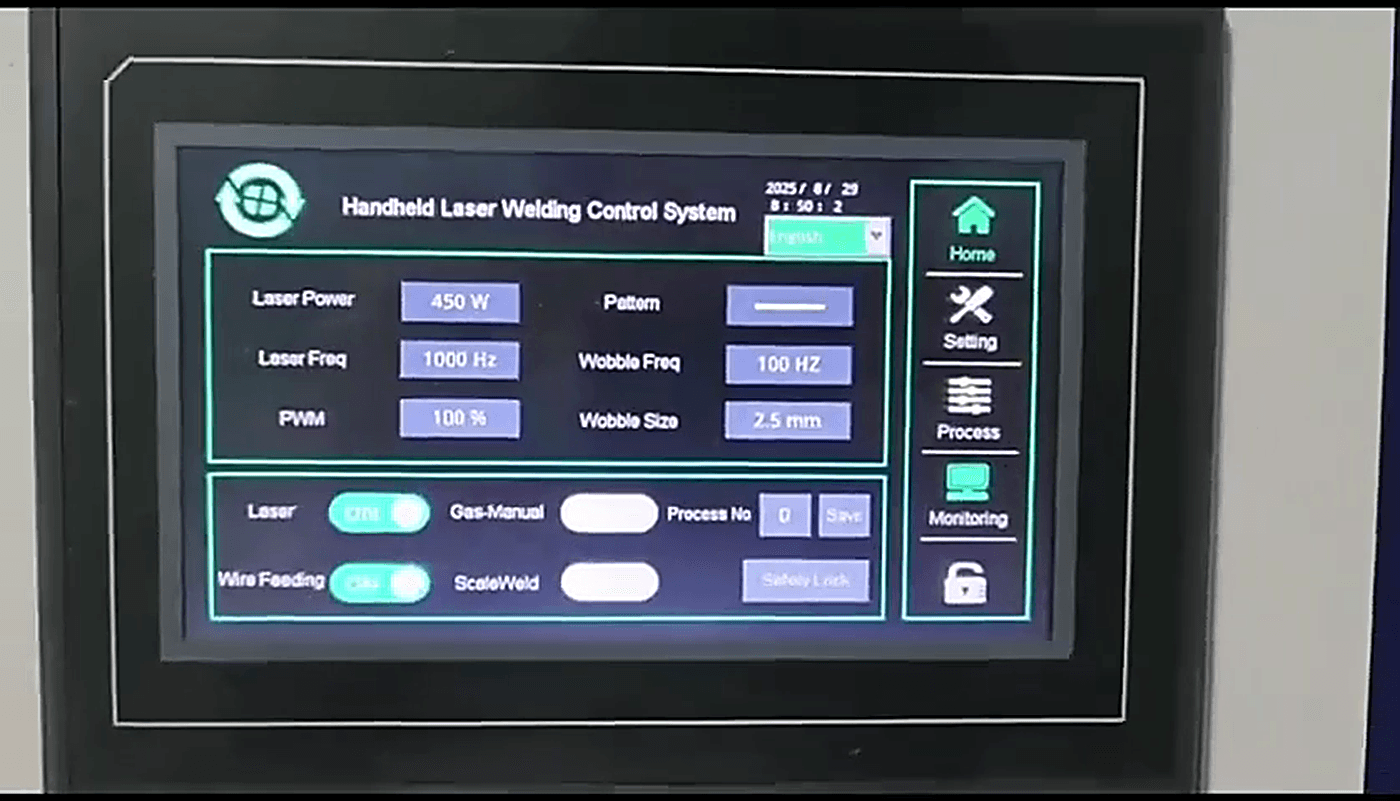
Quick Answer On the LY-1000 and LY-1500 handheld laser welding machines the beam oscillates at 0-100 Hz. Wobble widens the melt pool without requiring a wider joint preparation, which is why the same torch can close a tight seam and bridge a loose fit-up. Travel speed comes from the process chart: 1 mm stainless runs around 90 cm/min. Set power and wobble from the chart, then hold three things steady on the floor: the gap, the torch angle and the travel speed. 1. What wobble actually changes Without oscillation, the beam deposits energy in a spot roughly the size of the focus. Weld width is then a function of that spot and of how much the operator weaves the torch by hand. With oscillation at a set frequency, the beam sweeps a defined pattern at a defined rate, so the melt pool is widened by the machine rather than by the wrist. That is the difference between a weld that repeats and one that looks different on the second part. Wobble also changes how the heat is distributed across a gap. A wider sweep spreads energy over a larger area, which bridges a poor fit-up without a second pass, but the energy per unit length falls as the sweep widens. This is why frequency and travel speed have to be set together: raising the frequency alone, at the same speed, thins the energy going into the joint. 2. Reading the chart by thickness The process chart is organised by material and thickness, and it gives a starting power and a starting travel speed rather than a range to explore freely. For 1 mm stainless, the chart value is around 90 cm/min. The number matters less than the habit it creates: the first part is welded to the chart, not to the operator's memory of the last job. Both the LY-1000 and the LY-1500 share the same beam quality figure, BPP below 6 mm mrad, which is what allows the beam to be delivered through a fiber and still focus to a small spot at the work. The 1500 W unit gives more headroom on thicker sections; on thin sheet the difference between the two machines is mostly how much of the range you use, not how they behave. 3. Gap and fit-up: the variable the chart cannot fix A process chart assumes a joint that is tacked, aligned and closed to a normal gap. When the fit-up is loose, the beam passes through the gap and puts energy into the backing or into the air. Wobble buys tolerance, but it does not replace tacking discipline. The practical sequence is to close the gap first, tack, check the tack, then weld to the chart. Shops that skip the tack and open the wobble instead end up with a weld that looks wide and holds less than it should. The same logic applies to the surface. A joint that has been sitting in the shop picks up oxide and oil, and a weld over that film traps it. Cleaning the joint before welding is part of the chart, not a separate step that can be skipped when the schedule is tight. 4. Holding the numbers on the floor Three things move a weld away from the chart, and all three are operator-side. The first is gap: a joint that opens up mid-run needs a re-tack, not a slower pass. The second is angle: the torch has to stay at the angle the chart assumes, because a tilted head changes how the wobble pattern lands in the joint. The third is travel speed: speeding up thins penetration, and slowing down piles heat into a thin section. The way to make the chart stick is to write the settings on the job card, not on the machine. Then a second operator, on a second shift, welds the same part the same way, and a change in the finished weld points to a real variable instead of a habit. FAQ Does higher wobble frequency always make a wider bead? Not on its own. The oscillation range is 0-100 Hz, and the resulting weld width also depends on the spot size at the work and on how fast the torch travels. Frequency sets the sweep rate; travel speed sets how much of that sweep lands on a given length of joint. Can the same setting weld stainless and carbon steel? No. The process chart is organised by material and thickness, and the two materials do not share a starting point. Set from the chart for the material in hand, then adjust on a scrap piece of the same alloy and thickness. What happens if travel speed is raised above the chart value? Penetration and bead width both drop, and the risk of lack of fusion rises, especially on a joint that is not perfectly closed. If a part has to be finished faster, the correct change is to confirm the result on a test piece at that speed, not to assume the chart was conservative.