Guia
Handheld Laser Welding Machine LY-1000/1500: Process Settings and Applications
How the LY-1000/1500 handheld laser welder is built and set up: fiber delivery, swing head, process table for stainless, carbon steel, galvanized and aluminum, plus the double interlock.
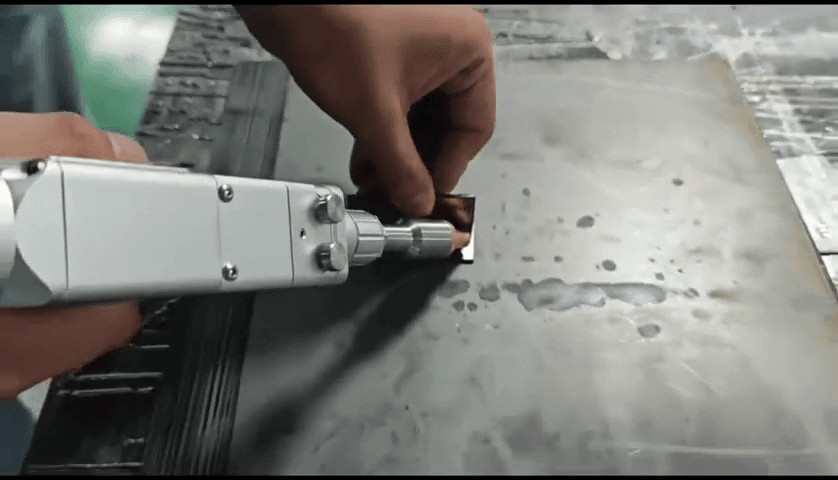
Quick Answer: The LY-1000/1500 is a handheld fiber laser welding machine rated at 1000W or 1500W average power. The beam travels through a 7 m or 10 m fiber with a QBH interface to a swing welding head, so the operator can weld, tack and repair by hand. The system is water-cooled, rated for 24-hour continuous work, and protected by a double interlock that requires nozzle contact before the laser fires. 1. Power and Beam Delivery Average power is 1000W or 1500W in continuous mode, and the output can be modulated up to 20 kHz. Power instability stays under 2%, and power is adjustable from 10% to 100%. Beam quality is BPP better than 6 mm*mrad, which is what keeps the spot tight enough for welding rather than cutting. The fiber runs 7 m or 10 m to the head through a QBH connector, and the unit is water-cooled and rated for 24-hour continuous operation. 2. The Swing Welding Head The head swings the beam across the seam instead of holding one point. Swing frequency runs from 0 to 100 Hz and spot diameter adjusts from 0 to 6 mm, which widens the bead, bridges small gaps and reduces the tendency to burn through thin sheet. Focus length is 120 mm or 150 mm depending on reach and thickness. The protective lens is 18 x 2 mm, the interface is QBH, and maximum assist gas pressure is 15 bar. The head carries its own speed control board, so it stays compact and light in the hand. 3. Process Table for Common Metals Our process table gives starting points by material and thickness. For stainless steel with nitrogen or argon: 1 mm plate uses 1.0 mm wire at 90 cm/min, 2 mm uses 1.2 mm wire at 75 cm/min, and 3 mm uses 1.6 mm wire at 60 cm/min, with scan width of 2.5 mm, 3.0 mm and 3.5 mm and scanning speed of 300 mm. Carbon steel and galvanized sheet use a mixed shielding gas. Aluminum is welded with nitrogen. At 1 m/min, penetration is about 2.06 mm on LY-1000 and about 3.1 mm on LY-1500. Always run a test piece before a production run. 4. Safety Interlocks and Handling The machine uses a dual-layer interlock: a touchscreen button plus a mechanical button, with a safety circuit that only allows emission when the air nozzle contacts metal. The nozzle opens in one direction only, which helps block spatter and reduces reaction force. The internal laser is Class 4 under EN 60825-1, emitting around 1064 nm or 1080 nm, so certified wavelength-matched goggles must be worn for the entire process. Never aim the head at people or at mirror-finish surfaces, and always connect the unit to a reliable PE ground before powering up. FAQ Q: What is the difference between LY-1000 and LY-1500? A: Average power: 1000W versus 1500W. On the same 1 m/min travel, the process table shows about 2.06 mm penetration on LY-1000 and about 3.1 mm on LY-1500. Q: Why use a swing head instead of a fixed spot? A: Swinging spreads the energy across a wider path, which bridges gaps, smooths the bead and reduces burn-through on thin material. Q: What safety feature prevents accidental emission? A: A double interlock — touchscreen button plus mechanical button — with a circuit that only fires when the nozzle touches the workpiece.