Guia
Laser Cleaning vs Sandblasting and Chemical Stripping: What Changes on the Shop Floor
A grounded look at what a 300 W pulsed laser cleaning machine replaces on the shop floor, and which four settings the operator actually controls instead of grit size and bath concentration.
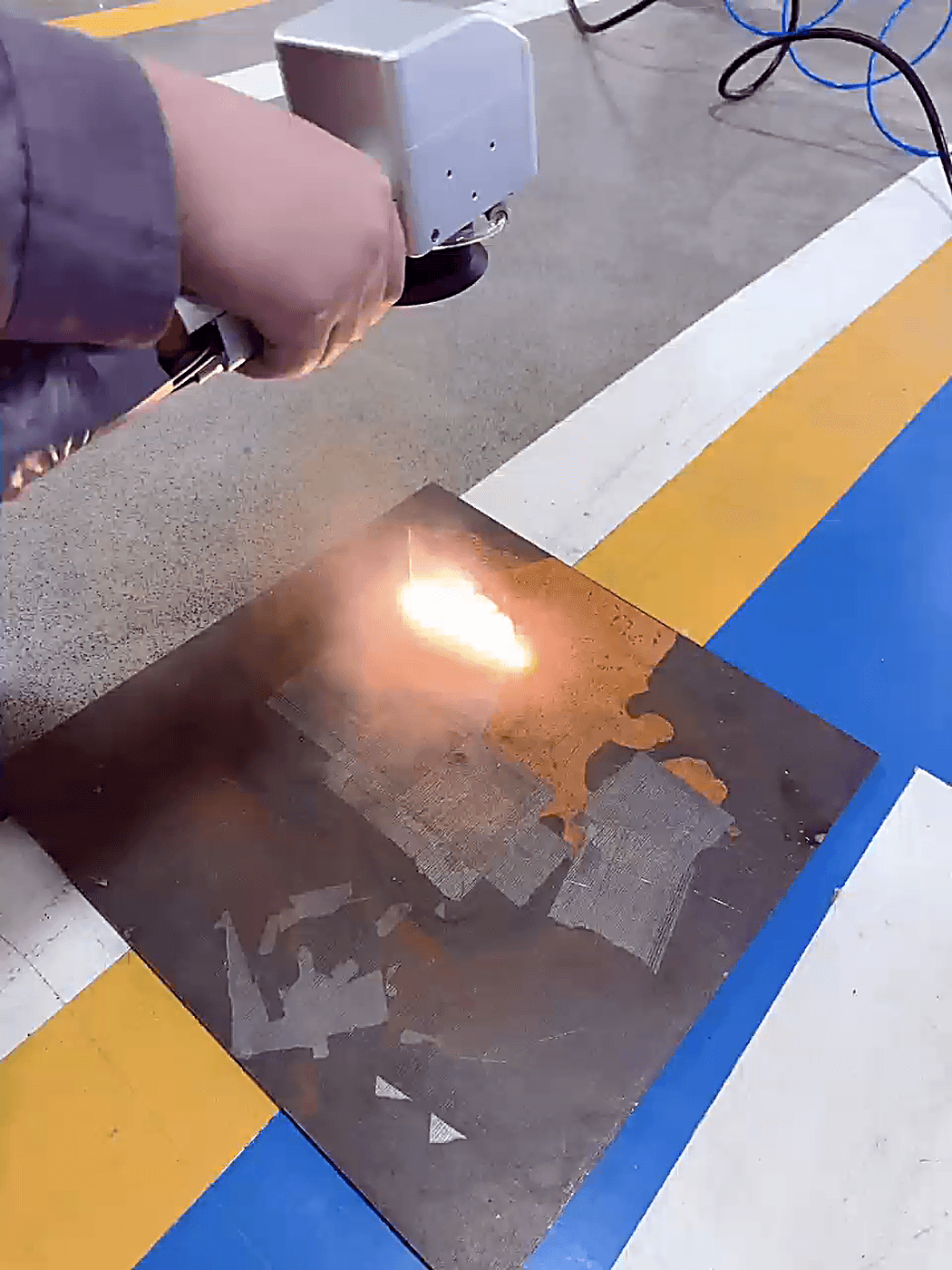
Quick Answer A pulsed laser cleaning machine removes rust, paint, oxide and oil film by ablating the surface layer with a focused beam. There is no blasting media to buy and no chemical bath to mix or dispose of. The LY-FLC300M delivers 300 W through 80-500 ns pulses, up to 13 mJ per pulse, at a repetition rate of 10-1000 kHz, across a 0-145 mm scan field with eight scan modes. What the operator changes is power percentage, frequency, scan mode and travel speed. The depth of removal is set by those four numbers, not by grit size or bath strength. 1. What the beam removes, and what it does not The beam works on what sits on top of the metal: rust, mill scale, paint, primer, oxide from welding, and oil or release film. It does not fix what is wrong underneath. A pitted surface stays pitted after the rust is gone, and a part that has already lost wall thickness does not get it back. This matters when a blasting cabinet has been used to hide deep corrosion: laser cleaning makes the real surface visible, which is useful before welding but can be uncomfortable on a part that has been in service for years. It is also a line-of-sight process. The head must see the area it cleans, so deep internal corners, blind holes and the back side of a welded assembly need either a different angle or a different method. A 5 m fiber and a head under 1.6 kg make those angles easier to reach, but they do not turn a shadowed area into a reachable one. 2. What the operator controls instead of grit and chemistry With blasting, the operator picks a media, a pressure and a distance. With chemicals, the operator picks a concentration and a dwell time. With a pulsed laser, the operator picks four things: power percentage from 10 to 100 percent, repetition rate from 10 to 1000 kHz, one of eight scan modes, and how fast the head moves across the part. Pulse width is fixed in the 80-500 ns range by the machine, and the maximum single pulse energy is 13 mJ. The practical rule is that a heavy layer and a thin film are two different jobs on the same part. Heavy mill scale comes down with a wide scan field and higher power; the residual film underneath is finished with a narrower field at lower power so the base metal is not marked. The F254 field lens gives a 20 mm depth of focus, which means the head does not have to be held at a single exact distance to keep working, an advantage when the surface is curved or the operator is working overhead. 3. Waste, consumables and shop logistics A blasting cabinet produces used media and dust that must be contained and disposed of. A chemical line produces a bath that has a life and a disposal route. A laser cleaning machine produces neither. Its inputs are electrical power and cooling water, and its upkeep is concentrated on the optical chain in front of the beam and on the cooling loop. The LY-FLC300M is water cooled, runs on single-phase 220 V, and the complete machine draws under 3000 W. That is a wall socket plus a water circuit, not a three-phase service and not a compressed air line. For a shop that already runs a blasting cabinet and a chemical dip tank, the practical change is not only the cleaning step: it is the space, the containment and the disposal that the cleaning step used to require. 4. Where it fits next to a blasting cabinet The two methods are not always a replacement story. Blasting is fast on large, flat, heavily scaled surfaces and needs no masking for most structural work. A pulsed laser is better where masking would be expensive, where the part is too large to move into a cabinet, where a weld prep needs a controlled depth of removal, or where the shop cannot carry the dust and the disposal of a blasting operation. Many shops keep both and route work by part size and by how much control the joint needs. The honest way to decide is a trial on your own parts. Send a scaled plate, a painted panel and a piece of the thinnest sheet you weld; the difference between the two processes shows up on the third part, not on the first. FAQ Is laser cleaning safe on thin sheet? The machine gives pulse widths of 80-500 ns with a maximum single pulse energy of 13 mJ, and power can be turned down to 10 percent. That combination allows a shallow, layered removal instead of one deep pass. Whether a specific thickness is acceptable depends on the alloy and the surface, so the check is a trial piece from your own stock, inspected after cleaning. Does laser cleaning remove mill scale as fast as blasting? There is no single speed figure that applies across materials, because removal rate depends on power percentage, repetition rate, scan field and travel speed together. The machine's scan field runs from 0 to 145 mm, and a wider field covers more area per pass at the cost of energy density. The realistic comparison is total time per part, including masking, media handling and cleanup. Can it run on a normal wall socket? Yes. The LY-FLC300M is single-phase 220 V with water cooling and draws under 3000 W for the complete machine. The requirement to plan for is the cooling water circuit, not a three-phase supply.